
Radiation Monitoring Instruments (RMIs)

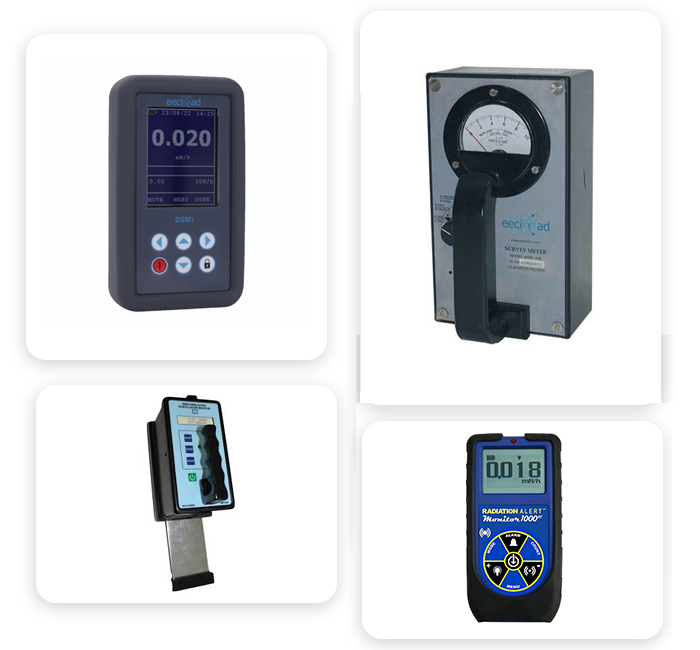
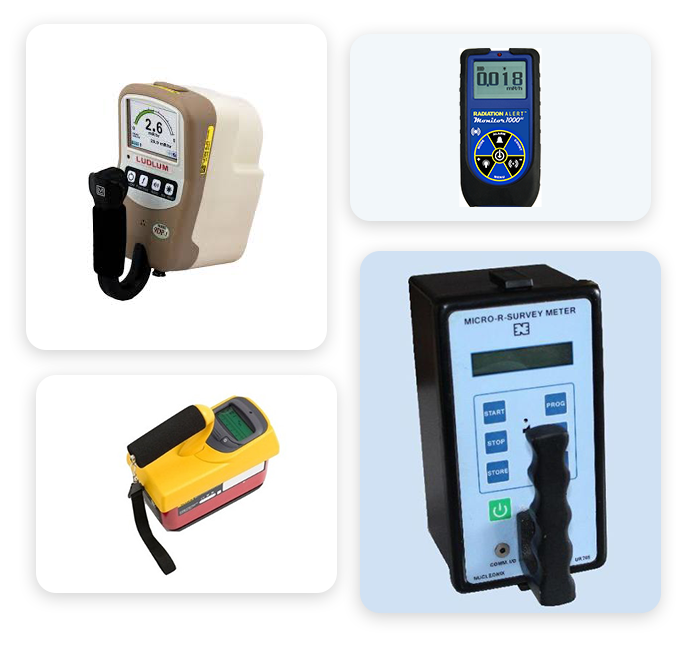
Survey Meters

What it does:

Portable, handheld devices (typically Geiger-Müller counters or Pressurized/non pressurized Ion Chambers) used to detect and measure ambient ionizing radiation fields. They provide instantaneous readings of dose rate (e.g., mR/hr or µSv/hr) to identify the presence and intensity of radiation.

Need:

Essential for routine surveillance, locating lost sources, checking shielding integrity, and ensuring that radiation levels in public and occupational areas remain within safe limits.

Radimage's Calibration Role:
  • Regulatory: Calibrated to ensure response linearity and energy dependence meet AERB safety codes.
  • Process: Radimage exposes the meter to known standard radiation fields (Co-60) to verify its reading accuracy across its entire measurement range.
Pocket Dosimeters (DRD - Direct Reading Dosimeters)

What it does:

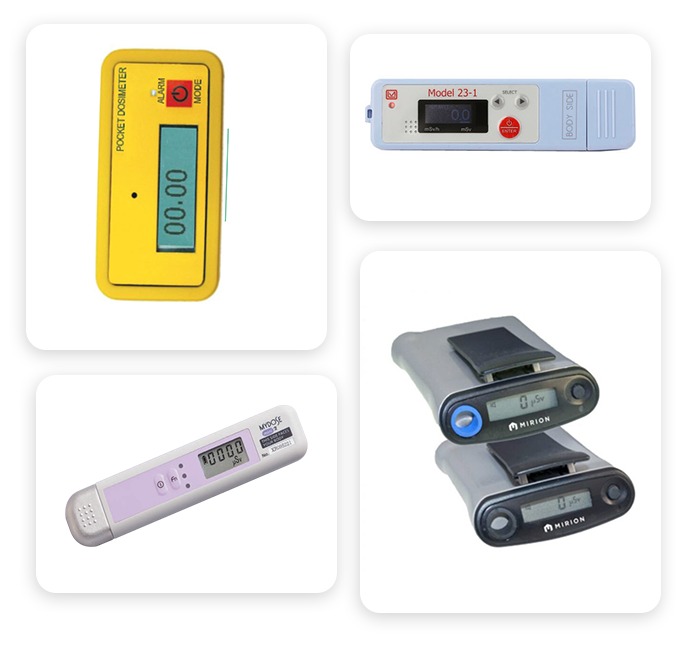
Small, pen-sized devices worn by personnel to measure the accumulated radiation dose over a specific period (e.g., a work shift). They can be analog (quartz fiber) or digital (electronic personal dosimeters).

Need:

Provides immediate feedback to the wearer about their total exposure, allowing them to manage their time in radiation fields to prevent overexposure (ALARA principle).

Radimage's Calibration Role:
  • Regulatory: Mandatory to ensure the device accurately records accumulated dose without significant "leakage" (drift) over time.
  • Process: Radimage tests for electrical leakage (self-discharge) and response accuracy by exposing the dosimeter to a known dose and comparing the displayed value.

Area Monitors (Zone Monitors)

What it does:

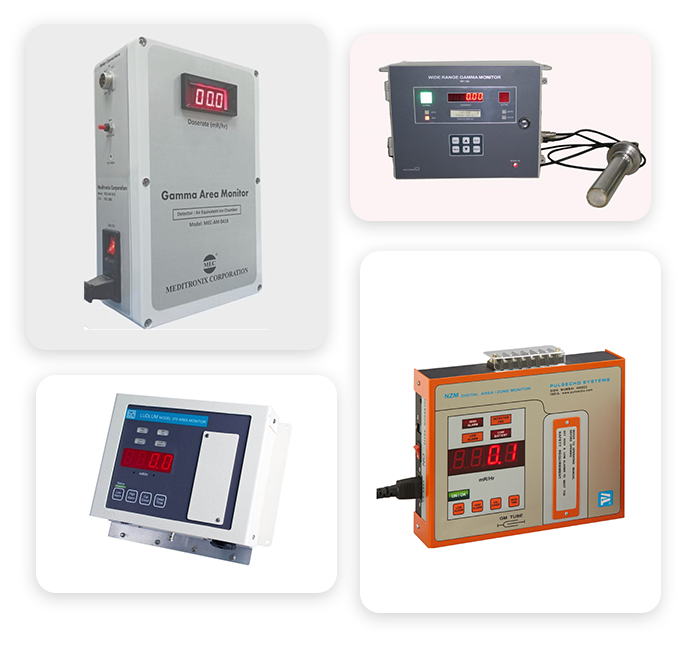
Fixed, wall-mounted detectors placed in strategic locations (e.g., near Cobalt machines, Linac bunkers, Brachytherapy rooms, Hotlabs, Cyclotron Centres, power plants etc). They continuously monitor radiation levels and trigger visual/audio alarms if levels exceed preset thresholds.

Need:

Acts as a safety interlock system to warn staff of high radiation levels before they enter a controlled zone, preventing accidental exposure.

Radimage's Calibration Role:
  • Regulatory: Ensures the alarm set-points function correctly during radiation emergencies.
  • Process: Radimage calibrates the detector response and verifies the functionality of the exposure rate, alarm logic and remote indicators.

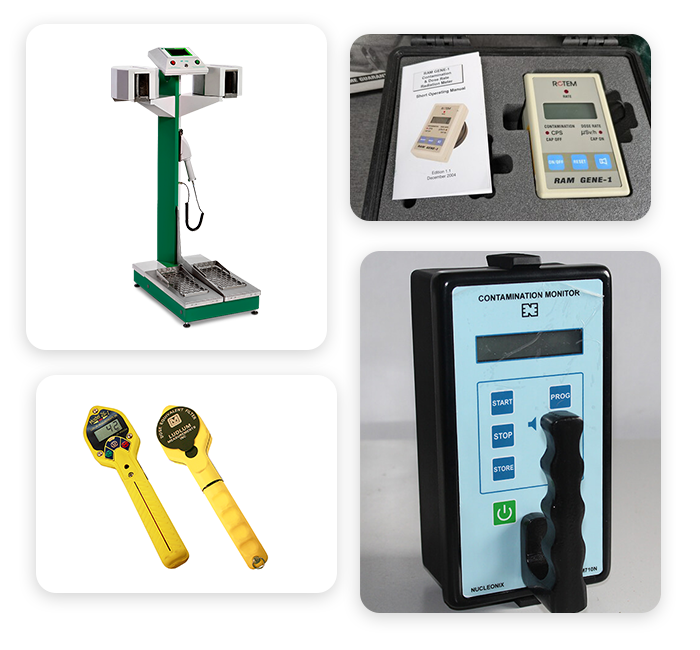
Survey cum Contamination Monitors

What it does:

Versatile hybrid instruments equipped with external probes (or internal switching) capable of measuring both ambient dose rates (like a survey meter) and surface count rates (contamination).

Need:

Cost-effective solution for facilities requiring both area monitoring and spill detection, such as smaller radioisotope labs or transport agencies.

Radimage's Calibration Role:
  • Regulatory: Requires dual-calibration verification—one for dose rate accuracy (Sv/hr) and one for count rate efficiency (CPS/CPM).
  • Process: Radimage verifies the instrument's response to both gamma fields (dose) and beta/alpha sources (contamination).

Contamination Monitors

What it does:

Specialized instruments with large surface-area probes (pancake GM or scintillator) designed to detect radioactive material deposited on surfaces (clothing, skin, workbenches, floors).

Need:

Crucial for infection control in Nuclear Medicine and identifying radioactive spills. It prevents the spread of radioactive material outside controlled areas.

Radimage's Calibration Role:
  • Regulatory: Must quantify detection efficiency for specific isotopes used in the facility (e.g., I-131, Tc-99m).
  • Process:We determine the instrument's detector efficiency and provide a conversion factor using large-area planar standard sources (Am-241, Sr-90, etc.) to ensure contamination detection.
You may fill out the form directly, or download the form, complete it, and send it to radimagehealthcare@gmail.com

RMI CALIBRATION REQUEST FORM

AERB Approved & NABL Accredited Laboratory (ISO/IEC 17025:2017)

Please complete all sections. Incomplete forms may delay processing.
(Please use separate form for each instrument)

1. Customer Details
2. Instrument Details
3. Calibration History
4. Declarations & Terms
1. Customer Declaration:

I hereby declare that the instrument submitted for calibration is in the condition as marked above (Working / Not Working). In case the instrument is not working, the reason has been clearly specified.

2. Terms & Conditions:

Calibration will be performed in accordance with ISO/IEC 17025:2017 methods and procedures (ISO.org). NABL accreditation requirements (nabl-india.org) and AERB safety guidelines. Radimage Healthcare reserves the right to refuse calibration of instruments not meeting safety or technical criteria.

Ready to dive in?
Register for our training programs today.

Lorem Ipsum is simply dummy text of the printing and typesetting industry. Lorem Ipsum has been the industry's standard dummy text ever since the 1500s, when an unknown printer took a galley of type and scrambled it to make a type specimen book.

Get In touch

Radimage Healthcare India Pvt. Ltd.

Contact Detail

Unit 1 : G-236, Sector-63, Noida - 201303

0120-4263270

Calibration Facility for: Radiation Monitoring Instruments and Dose Calibrators

Unit 2 : 503, Udyog Kendra II, Ecotech 3, Greater Noida - 201306

0120-4112417

Calibration Facility for: SSD Teletherapy and Brachy Well Chambers

radimagehealthcare@gmail.com, radimagecallab@gmail.com